
This is Part 3 of our three-part series on Virtual Editorial Offices. Part 1 explains what a Virtual Editorial Office is. Part 2 walks through how one works, step by step.
Choose a Virtual Editorial Office (VEO) provider on four things first: it must leave every editorial decision with your editors, protect manuscript and reviewer confidentiality, follow recognised publication ethics guidance, and commit to clear response times in writing. Fit with your manuscript system, subject expertise, reviewer management, reporting, transparent pricing and a clean exit come next. This checklist explains what to ask about each.
Why does the choice of provider matter so much?
A VEO writes to your authors and reviewers in your journal's name. Every acknowledgement, reminder and decision letter it sends shapes how researchers see your journal.
If the provider is slow, careless or oversteps its role, the damage falls on the journal, not on the provider. Indexing bodies also look closely at how consistently a journal runs peer review, so operational weaknesses quickly become indexing weaknesses.
The checklist: ten things to assess
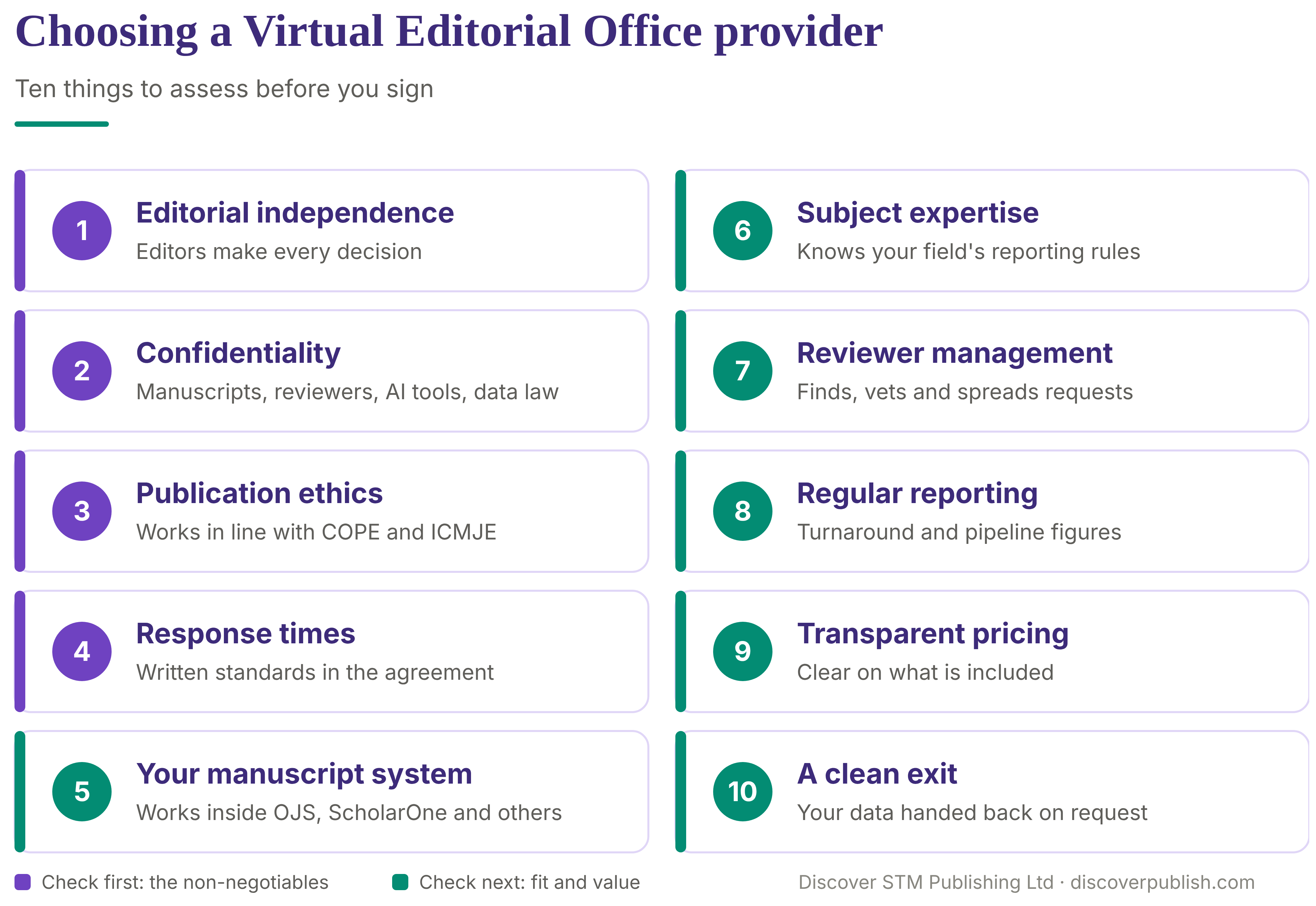
1. Does the provider leave editorial decisions with your editors?
This is the one point that is not negotiable. A VEO coordinates peer review; your editors decide whether to accept, revise or reject.
Ask how decisions are recorded in your system, and confirm that no decision letter is ever sent without an editor's approval. Check that the service agreement says the same thing in writing.
2. How does it protect confidentiality?
Unpublished manuscripts are confidential, and in double-blind review so are the identities of authors and reviewers. Ask who on the provider's team can see submissions, whether staff sign confidentiality agreements, and how reviewer identities are kept separate from authors.
Ask about AI tools specifically. Confidential manuscripts and reviewer reports should never be uploaded to public AI services. The provider should also comply with the data protection laws that apply to you and to them, such as GDPR in Europe or Saudi Arabia's Personal Data Protection Law.
3. Does it follow recognised publication ethics guidance?
A good provider works in line with guidance such as the COPE Core Practices and the ICMJE authorship criteria, and applies your journal's own policies.
Ask what happens when staff spot possible plagiarism, duplicate submission, image concerns or an authorship dispute. The right answer is that they flag it to the editor with the evidence, and the editor decides how to proceed.
4. What response times will it commit to?
Vague promises of "fast service" mean little. Ask for written standards, for example:
- how quickly new submissions are acknowledged and technically checked
- how often reviewers are reminded, and what happens when one goes silent
- how quickly author and editor queries are answered
Those standards belong in the service agreement, not only in a sales conversation.
5. Does it work inside your manuscript system?
Whether your journal uses OJS, Editorial Manager, ScholarOne or another platform, the provider should work inside it. That keeps every record in your journal's system rather than in the provider's inbox. Experience with your platform also shortens setup time.
6. Does it understand your subject area?
Technical checks are only as good as the person doing them. In medical and health sciences, for example, staff need to know reporting guidelines such as CARE, CONSORT and PRISMA, and to check ethics approvals, patient consent and trial registration. Ask what experience the team has with journals like yours.
7. How does it find and keep reviewers?
Finding willing reviewers is usually the slowest part of peer review. Ask how the provider identifies reviewers and checks author-suggested reviewers, for example by confirming institutional email addresses. Ask, too, how it avoids conflicts of interest and spreads requests so the same reviewers are not overloaded.
8. What reporting will you receive?
You should not have to chase the provider for an update. Ask for a regular report covering submissions received, decisions made, time to first decision, overdue reviews and reviewer acceptance rates. These figures also help when your journal prepares an indexing application.
9. Is the pricing clear?
Providers usually charge per manuscript, by monthly retainer, or in tiers based on submission volume. Ask what is included, what costs extra (language editing, typesetting, additional revision rounds) and how the price changes as your journal grows.
The cheapest quote is not always the most economical. A low price with no response-time commitments can cost far more in lost authors and delayed issues.
10. Can you leave cleanly if you need to?
Your journal's records belong to the journal: manuscript files, correspondence and the reviewer database. The agreement should state the notice period and how, and in what format, data will be handed over if you change providers.
Red flags that should end the conversation
- A promise of guaranteed indexing or guaranteed acceptance for authors. No provider can guarantee either.
- An offer to make or influence editorial decisions.
- Vague answers about confidentiality or the use of AI tools.
- No written response-time commitments.
- A price that does not say what is included.
- No current client journals you can speak to.
- Pressure to sign quickly.
Six questions to ask in your first call
- Who makes editorial decisions, and how is the editor's approval recorded?
- Who will see our manuscripts, and how is confidentiality protected?
- What response times will you commit to in writing?
- Can you work inside our manuscript system?
- What exactly is included in the price, and what costs extra?
- If we leave, how do we get our data back?
A note for journals in Saudi Arabia and the GCC
Two practical points are worth checking. First, coverage: the working week in Saudi Arabia runs Sunday to Thursday, while European teams work Monday to Friday, so ask when the provider's team is available to your editors and authors. Second, procurement: universities and institutions usually need a formal service agreement, invoices and registered company details, so confirm the provider can supply them.
How Discover STM Publishing Ltd approaches editorial office support
Our editorial office support covers manuscript workflow coordination, author and reviewer communication, and liaison with production. We work according to each journal's scope and policies, and each journal's editors and policies govern its editorial decisions. Dr Lesley C. Anson serves as our Consultant Editor.
You can read how we approach peer review and ethics in our Peer Review Policy and Publication Ethics and Code of Conduct. If you are weighing up editorial office support, we are happy to go through this checklist with you.
Frequently asked questions
What does a Virtual Editorial Office provider do?
It manages the day-to-day operations of a journal's editorial office: submission checks, peer review coordination, author and reviewer communication, and liaison with production.
Does a Virtual Editorial Office make editorial decisions?
No. A VEO coordinates the process; the journal's editors decide whether a manuscript is accepted, revised or rejected.
How much does a Virtual Editorial Office cost?
It depends on submission volume and the services included. Common models are a fee per manuscript, a monthly retainer, or tiered pricing. Ask any provider for an itemised quote.
Can a Virtual Editorial Office get my journal indexed?
It can help you run peer review consistently and keep the records indexing bodies look for. No provider can guarantee indexing; those decisions belong to the indexing bodies.
Can we change provider later?
Yes, provided your agreement covers notice periods and the handover of your journal's data.
Discover STM Publishing Ltd is based in Ireland and provides scholarly publishing and journal-hosting services. We publish and host a portfolio of nine journals for societies, universities and publishers. To discuss editorial office support for your journal, contact us at contact@discoverpublish.com.